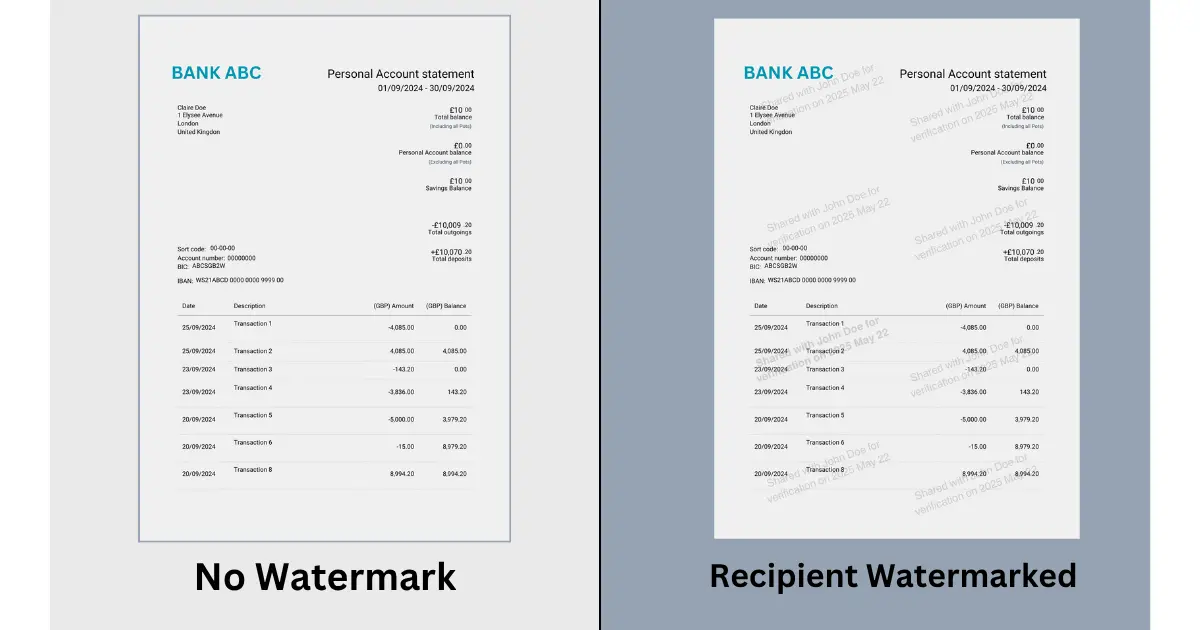
Bank statements are often requested as proof of income, address, affordability, source of funds, or financial standing. The request may be legitimate. The usual sharing method is where the risk starts: an attachment sent to an individual inbox, then forwarded to a colleague, downloaded to a laptop, and stored in a folder no one reviews later.
Secure sharing is not only about encrypting a file in transit. It is about making the whole exchange understandable and accountable.
Start with the purpose of the request
Before sending a statement, ask what the recipient is verifying and which information is actually required. A landlord may need evidence of income or account activity. A lender may require a defined period of statements. A compliance team may need them as part of a source-of-funds review.
The purpose should be specific. “Send your bank statement” leaves too much room for uncertainty. “Please provide your latest statement for affordability assessment” gives the sender a basis for deciding what to share and gives the recipient a basis for handling it.
Purpose limitation is also practical. When the reason for collection is recorded, the recipient can distinguish an active verification record from a file that no longer has a business use.
Minimise before you share
Review the statement for information unrelated to the request. Some organizations need the full document because they are checking authenticity or transaction history. Others may only need particular fields or a defined date range.
Do not redact automatically. Ask what the recipient needs to see, then remove information that is not necessary where the process permits it. Keep the original untouched if your own records require it, and make clear which version was submitted.
A watermark can add context to the copy. “For Example Lettings affordability assessment only — August 2026” is more useful than a generic “confidential” stamp. It does not prevent copying, but it makes the intended use visible.
Choose a controlled submission route
An organization collecting bank statements should provide a named, controlled route. A secure document request is preferable to asking people to guess whether an employee’s email address, WhatsApp account, or shared mailbox is appropriate.
The submission route should connect the document to the requester, the organization, the purpose, and the workflow. It should also give the sender confidence that the file is going to the right place. For the receiving team, it should avoid creating multiple uncontrolled copies across personal inboxes and local downloads.
Cloud storage can be useful once a record is inside an approved repository. It does not by itself govern the request, the sender’s identity, the review decision, or the retention action. Storage answers where a file is. Governance answers who is responsible for it.
What the recipient should be able to explain
A responsible receiving process should answer straightforward questions:
- Who requested the bank statement?
- What was the stated purpose?
- Who can access it?
- Was it reviewed, rejected, or replaced?
- How long will it be kept?
- What happens when the purpose ends?
If the receiving organization cannot answer these questions, the issue is not fixed by sending the attachment through a different app. The workflow needs ownership and lifecycle decisions.
Why email often becomes the weak point
Email is good for communication. It is poor at maintaining a single custody record for a sensitive financial document. Threads can be forwarded. Attachments can be saved outside the mailbox. Multiple versions can circulate without a clear status. A later deletion from one inbox does not necessarily remove downloaded or archived copies.
Messaging apps create a different version of the same problem. They are convenient for conversation, but the document may arrive between informal messages with no clear retention expectation or review history.
The better model is accountable collection: request, secure submission, scoped review, documented decision, retention, and deliberate deletion.
A simple sender checklist
Check the recipient’s identity and purpose. Remove unnecessary information when the process allows it. Add a recipient-specific watermark if appropriate. Use the recipient’s controlled submission route. Keep a record of what you submitted and when. Do not send a password or access code in the same message as the document unless the recipient has given clear instructions.
For organizations, the equivalent checklist belongs in the workflow itself. Staff should not have to remember every step from personal habit.
Bank statements deserve the same care as passports and identity documents. The safest exchange is one where both sides understand the purpose, the boundary, and the next lifecycle action.
See how CVOR supports governed document custody.
CVOR Guard helps you add recipient and purpose context before sharing sensitive documents.
Explore CVOR Guard →Frequently asked questions
Is it safe to email a bank statement?
Email may be convenient, but it was designed for communication rather than governed document custody. Forwarding, downloads, mailbox access, and retention are harder to control consistently.
Should I redact a bank statement before sharing it?
Redaction should follow the recipient’s legitimate requirement and your own obligations. Remove information that is not needed, but do not alter evidence required for the stated check.
Should I watermark a bank statement?
A purpose-specific watermark can discourage reuse and identify the intended recipient, but it should complement controlled submission, access controls, and lifecycle governance.