Stop collecting KYC documents through email.
Request IDs, proof of address, source of funds documents, beneficial ownership records, and other customer due diligence evidence through one controlled AML document collection workflow.

01
One evidence record for each customer, entity, or refresh workflow.
4
Core stages: request, submit, review, and complete.
0
KYC evidence needs to rely on inbox attachments or manual folder cleanup.
KYC document collection must support both onboarding progress and regulatory review.
Customer due diligence can involve IDs, proof of address, corporate structure records, beneficial ownership information, source of funds documents, bank statements, registry extracts, and enhanced due diligence materials.
Analysts need to move onboarding forward while maintaining a defensible record of what was requested, what was received, who reviewed it, and when evidence must be refreshed.

CDD and AML teams need evidence control connected to onboarding, review, and refresh.
Creates uncontrolled copies, forwarding risk, and weak evidence status across analysts.
Improve submission but may not connect review activity, access scope, or refresh state.
Store records but may not show which request a document satisfied or whether it was superseded.
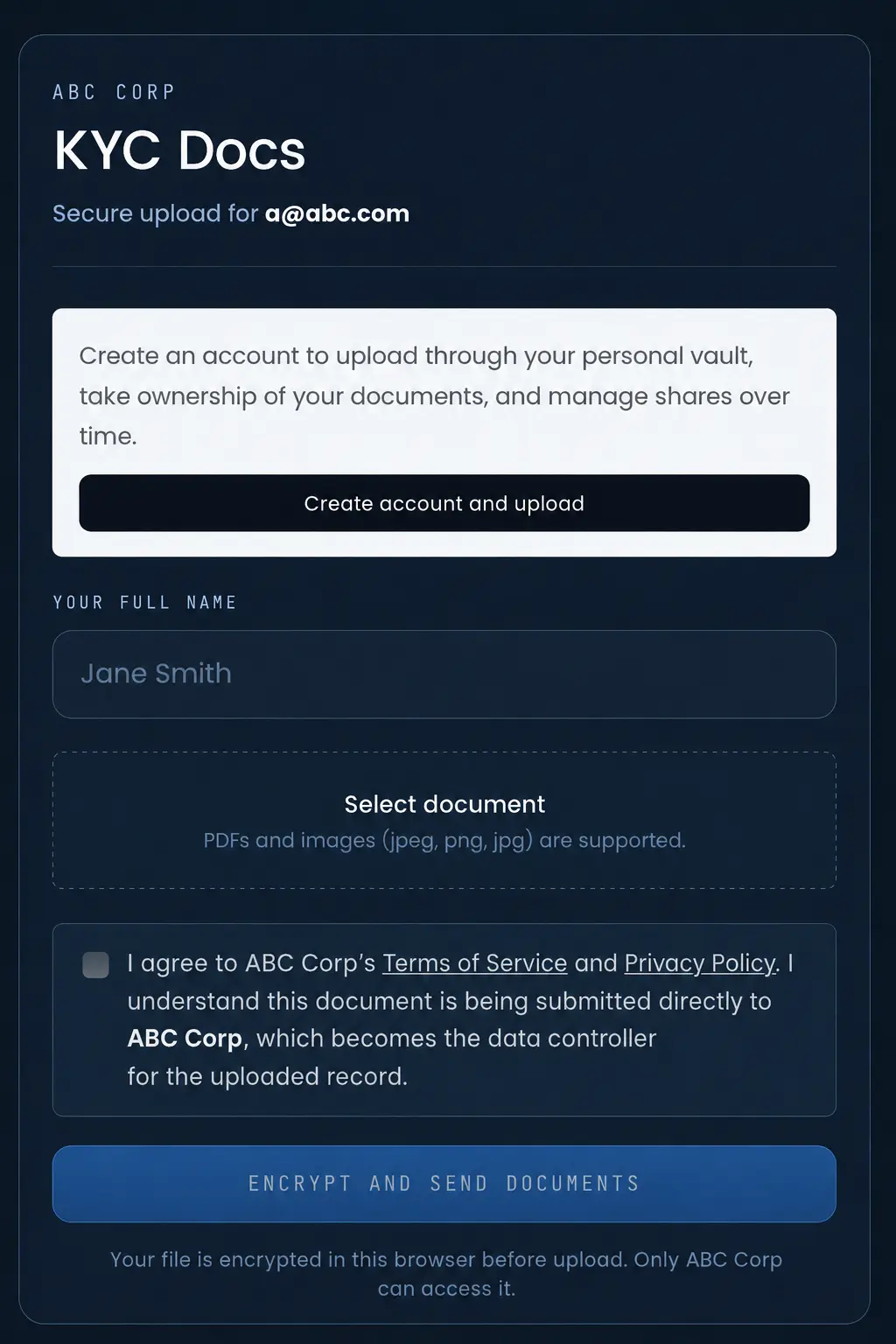
KYC document collection for CDD, EDD, onboarding, and periodic refresh.
Define required KYC evidence for the customer, entity, or refresh workflow.
Receive sensitive identity and financial records through a governed portal.
Give analysts and reviewers one custody record for evidence status and review actions.
Apply access controls, audit logging, retention, and refresh discipline.
The evidence controls KYC and AML teams need for defensible review.
Audit trail
Record what evidence was requested, when it arrived, who accessed it, and how it was handled.
Scoped access
Limit source of funds, identity, and ownership records to approved reviewers.
Document refresh
Collect updated or corrected KYC evidence without losing onboarding context.
Customer confidence
Give customers a credible workflow for sharing private identity and financial records.
Designed to support regulated evidence handling without replacing risk decisioning.
KYC workflows may be shaped by AML requirements, FCA expectations in regulated contexts, JMLSG guidance, and internal financial crime controls.
CVOR does not decide customer risk, perform verification, or replace AML controls. It provides governed document collection and custody so teams can maintain stronger auditability around evidence.
KYC document collection questions
Does CVOR perform identity verification decisions?
No. CVOR governs collection and custody of sensitive KYC documents. Verification decisions remain with the organization or its verification providers.
What KYC and AML documents can CVOR collect?
CVOR can collect IDs, proof of address, corporate records, beneficial ownership documents, source of funds evidence, bank statements, and enhanced due diligence files.
Can CVOR support periodic KYC refresh?
Yes. Teams can request updated customer due diligence documents while keeping the refresh connected to the original customer or entity workflow.
Move KYC document collection into governed custody.
Sales-led onboarding. We assess document types, reviewer roles, access boundaries, and retention requirements before onboarding.